
Daruma / Roji
Interior Architecture- Small Scale (<5,000 sf)
Project Narrative
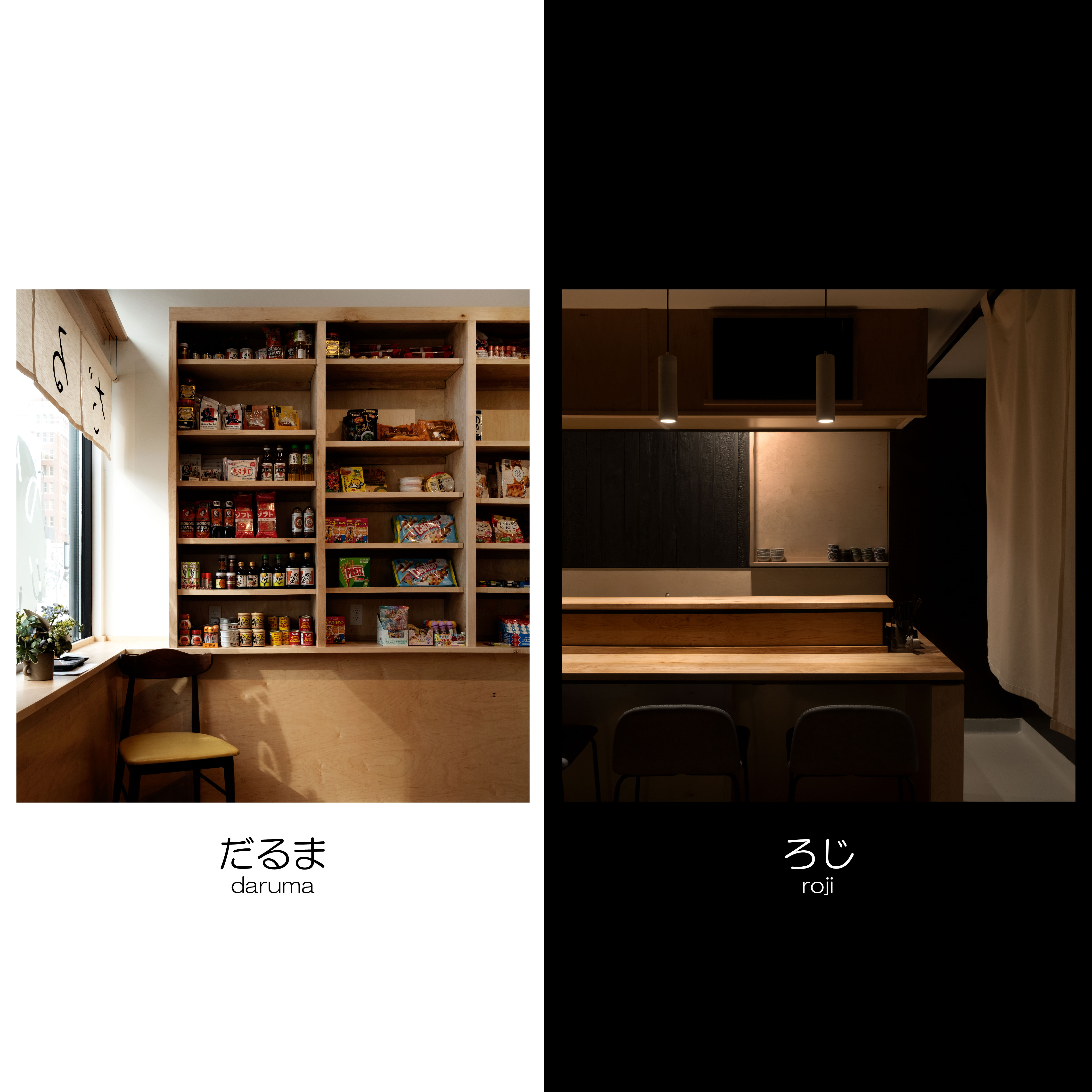
Daruma and Roji are two contrasting yet intertwined hospitality experiences occupying a single, extremely limited urban footprint. Facing the street, Daruma is a bright, grab-and-go Japanese convenience store designed to serve downtown workers with quick lunches and everyday goods. Hidden off the alley, Roji - Japanese for “alley” - is an eight-seat omakase bar, exclusive, reservation-only, and open only at night. These two worlds rarely cross, yet together form a single architectural composition of opposites: convenience vs. ritual, bright vs. dark, public vs. secret.
The project sits between street and alley on a narrow, elongated footprint. With space at a premium, every inch had to be purposeful. The two concepts needed to share a kitchen and infrastructure without sacrificing their distinct identities. There was no room for wasteful circulation, and the building’s shell could not be altered to create depth. The solution emerged through layering, texture, and efficiency.
Daruma is light, colorful, and accessible. Rows of products fill the walls, transitioning to warm wood shelving against crisp white surfaces. Generous daylight reinforces its openness, while even the point of sale, handled by a compact self-scanner, underscores efficiency and informality.
Roji is immersive and cloistered. Guests enter from the alley into a world of ritual and intimacy. Soft fabric noren curtains enclose diners at a monolithic natural cedar sushi bar. Concrete point lights cast precise pools of illumination against a backdrop of blackened yakisugi (charred cedar), balancing purity of material with high drama.
Instead of relying on the shell walls, both spaces use overlapping layers of wood, plaster, fabric, and product display to define depth. The shared kitchen at the center becomes the hinge between two distinct atmospheres.
The design converts constraint into opportunity. By treating texture and material as the true “walls” of the project, the spaces achieve richness without expansion. Daruma thrives as a reliable neighborhood fixture for quick meals and supplies. Roji has quickly earned a reputation as one of Cincinnati’s most transportive dining experiences, where intimacy and exclusivity are heightened by the architecture itself.
Together, the two venues introduce a cultural model rarely seen in the Midwest: the coexistence of convenience and ritual within a single footprint. The project demonstrates how architectural clarity and bold contrast can create environments that are not only functional but unforgettable.


Project Details -
Submission Category
Interior Architecture- Small Scale (<5,000 sf)
Date of Completion
February, 2024
Submitting Firm Name
Team B Architecture & Design
Project Team
Architect
Team B
Interior Designer
Team B
Other Project Team Members
Team C (Millwork)
Structural Engineer
Structural Engineer
MEP Engineer
MEP Engineer
Civil Engineer
Civil Engineer
Contractor
Trade 31